Thursday, December 5, 2013

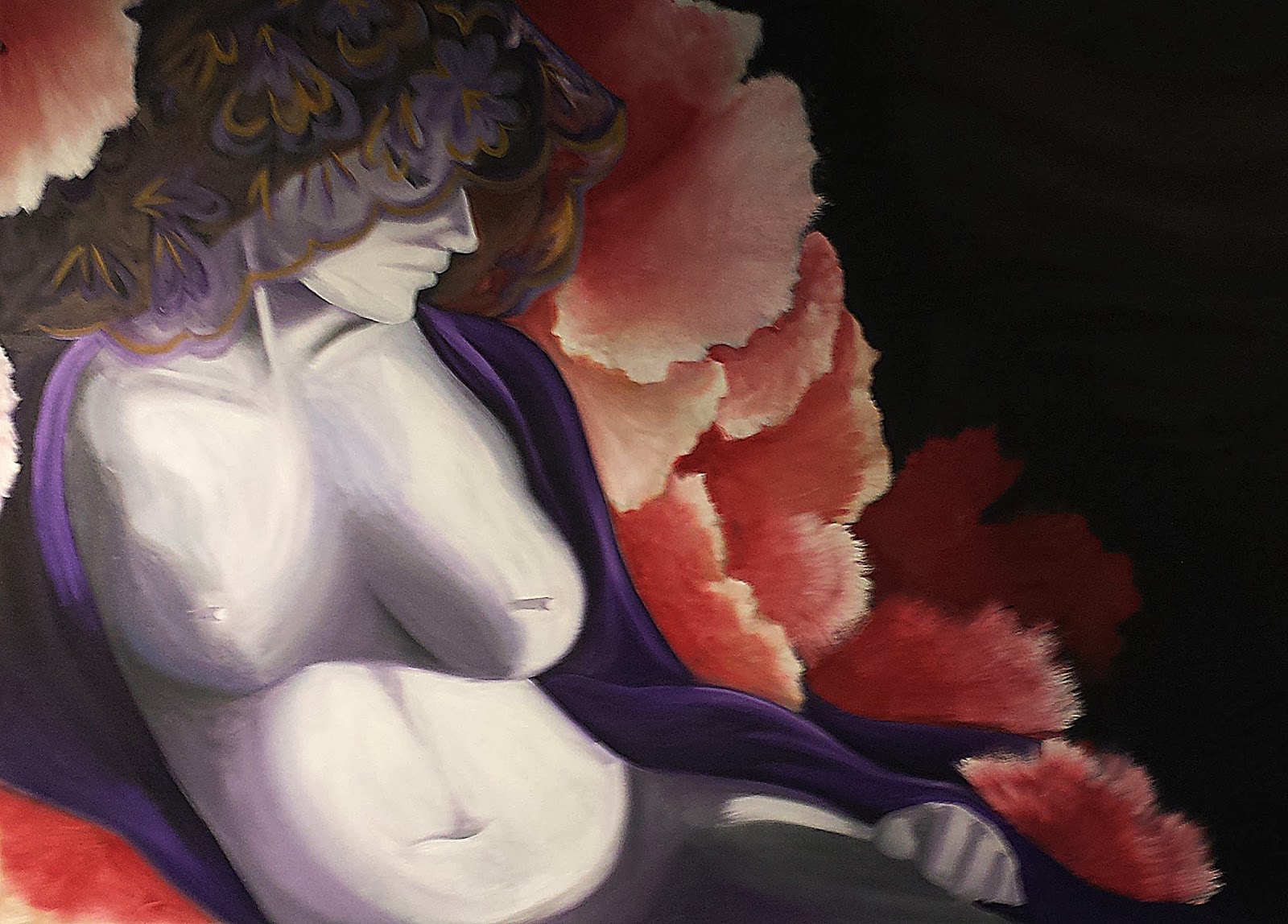
FINAL PROJECT, Part 1
oil on canvas

FINAL PROJECT, Part 2
oil on canvas

Jeffrey Bryant

Figure Painting Artist Statement 

The word artist and art have become very vague and hard to define. We tend to make art this thing that is so lost in the idea of what art is supposed to be that we forget what art is really all about.

I am a strong believer that art is something we all do naturally and is happening all around us while we are blindly participating in art movements and shows all day. When I make art I usually want to make it because it makes me feel good and takes me a place where I am the controller, and I make the decisions that are going to be portrayed to my viewer.

Typically I tend to strive for narrative in my pieces and I feel like most art has for centuries told a story. Artists of the past have done art for the very reasons we still do today. We use art to explore “modern” ideas and express our feelings and voice on the subject. The voice is something that I believe all artists including myself are searching for, even though it has more than likely been there all along. It creates a journey and for me that is one of the best parts about making art.

In my final project I divided the figurative models into two separate pieces, which are meant to stand-alone. In one painting I used a style that I feel is very comfortable for me and I played with many ideas of dualism and symbol and meaning of balance between those. From water and fire, the moon and the sun, and the man and the woman. All are opposite but vital for one another creating balance and harmony.

The second piece, which I chose to take a step away from how I would typically approach a figure painting, was focused on energy. I wanted to try to purely capture energy on canvas with the idea of the figure. The paint was applied in a manner where I could feel the color and move the thick oil paint on the canvas. I layered over my first figurative painting I wanted to renovate my style and bring in something fresh. Color for this painting wads important and I wanted to use colors that expressed the flesh the way I felt the energy and less of the
relying of the eye. 

FINAL PROJECT
acrylic on mylar with foam core

Detail 1

                            
Detail 2 & 3

James Schlavin

Artist’s Statement

As an artist I see myself not as a creator but as an observer, analyst, and interpreter. I seek to see the world constantly in a deeper way, as an individual. By looking at the world in this way I see the world more intentionally. I want to analyze the aspects that I find interesting, unique, and amazing so that I can understand what intrigues me more deeply. Finally I interpret the world. By creating works that are unique I interpret the world through my eyes. While this is assuredly not the only interpretation, I strive to make it true for myself as a person, and as an artist.


At the start of this semester we completed a simple figure study. I began this the way I always work by looking at the model, analyzing the proportions and trying to find what was special about that painting, and in the end it turned out to be the colors that I saw as most important in the way they took over the painting in a way that rarely happens in my work.

In my second painting I began using color to block out the figure. I challenged myself to leave distinct blocks of color for as long as possible with that painting until the very end when I sculpted it just enough to bring out the form. By doing this I allowed color to control my work from the very beginning so that I could interpret it the way I wanted to as an artist.

In my self portrait I decided that color itself would define the entire project. I wanted to observe the colors of my subject ­ myself ­ so that I could really look at how they interacted with one another. Throughout the project the concept of interaction became less important while the idea of distillation began to take over. At the end these competing ideas created the tension of identity in my piece that made it a success in my mind.

For this piece I began by simply observing the models. After several sketches, the idea of using colors again began to take over, so I decided to balance a study of figures with a study of color. By creating a collection of thumbnails I was able to complete both an intensive study of facial structures while continuing to look at color distillation in these figure studies.

Throughout this semester I have seen myself grow as an artist technically in how I look at the world through each of these projects, especially in the way that color studies have become an important part of how I work. Beyond that my conceptual creativity has also grown in the ways I have sought to interpret my ongoing analysis of color in painting. Ultimately I hope to continue being an artist ­ an observer, analyst, and interpreter ­ in every aspect of my life. 

 FINAL PROJECT
watercolor and ink on paper with twine

 Detail 1

Detail 2

Detail 3

Detail 4

Detail 5

Diego Villegas

Elementum

“The only constant in life is change” -Heraclitus

Elementum is an attempt to comment on human connection and change. In this piece, I convey people as creatures of change, connected and disconnected. I use symbolism and color to create the space needed to suggest this strange paradox of attached and separate.

I begin this piece by thinking about what is important to me –what I need to express about my life at the given moment. I thought about my relationships with people, the ebb and flow of intimacy with family, friends, lovers, etc. The passage of time became the pivotal factor in my choice in concept. My relationships with the people around me change constantly with time; I have no solid counterparts, because we are all fluctuating within ourselves.


The painting consists of five figures distributed among five major frames and three minor ones. The assembled frames make up the shape of a cocoon, symbolizing the constant metamorphosis that embodies the entire piece. The winged figure to the far left symbolizes someone in the act of escaping. A type of change that feels that it cannot be in one place for too long. This type of change is one that feels change is essential. Like the air, she may be fleeting, and impossible to catch. She flies backward -making sure her exit is unnoticed. The second figure is seated with the mountains. He is the figure that believes he is not changing, but the landscape slowly changes around him. As he sits, his perception changes. He watches the world transform, and in this sense, he is slowing becoming the observer, the wallflower, the Wiseman. Like stone, he doesn’t move, but the elements shape him, smoothing and roughening him; he is changed by his surroundings. The third figure stands in a very dynamic pose. In yoga –this pose is called Standing Bow. It is a pose that can only be held for a limited amount of time. His muscles begin to tire and his balance begins to waver. He is a highly energized form of change. He is a sudden burst –a sprint, if you will, that is very focused, and very strong. But if nothing can replenish him, he loses focus and energy. Like a fire, he has the potential to be very
fickle, but is filled with passion and life. His flames feed on fuel, and must be fed in order to maintain spirit. The fourth figure at the bottom right of the series represents a gradual but durable type of change. This type of change is a sort of development or slow evolution. Like plants, this type of change is slow to grow, taking in energy from the sun, from fertile soil, and from water. It is a change that is weak at first, not knowing if his purpose will remain the consistent, but as he matures, he becomes confident of his purpose, and moves toward it with more confidence than before. In some ways, the purpose of this type of change is to always be growing into something stronger. The fifth and final figure to the top right of the series represents an intangible change. She is misunderstood, and very different from the rest. Looking in the opposite direction of the other figures, she seems to overlook them. In a way she is above them, but is underwater, which is logically impossible in comparison with the rest of the frame. Like water, she has no fixed shape of form. She can be as wild and terrifying as the sea while being as still and as calm as an untouched lake. She is like air in the sense that she is not easily grasped, but still able to be held. She cannot be put in a cage, but yet she can still sit in the palm of your hand. She gives life, but can also take your breath away. This is the type

of change that we cannot fully understand due to the infinite paradoxes that make her so unique. 

FINAL PROJECT
oil and beeswax on canvas


Detail 1-3 

Detail 4

Detail 5

Cheyne Bishop

Artist Statement 

Throughout my life I have enquired a certainty for nature and what it beholds. The truth of outside is no different than the truth within a studio. There are sets of rules that allow you to proceed with the way of your will. Now this certainty has shown me the correlation between my paintbrush strokes and the growth of an organism. Every minute I work on a painting it grows and grows until the product is reached. Within nature a plant grows and grows until a product is reached. See there is a symbiosis between nature and me, I need it and it needs me. We take care of each other... so what better way to show this symbiosis other than through a visual projection. I paint to show the connection between you, me and organic truths of nature. 

FINAL PROJECT
oil on canvas

Charity Delaney

FINAL PROJECT
acrylic on foam core and canvas

Detail 1

Detail 2

Detail 3

Amy Wynia


Artist Statement

page1image2464

Have you ever thought about how many people think about you? It’s so bizarre. Imagine someone, out of the blue, thinking of your face. Something happens; they remember you. Your favorite song, how you dress, the way you talk, the look in your eyes when you are happy. They remember that about you, even if you haven’t seen each other in years. Everything in life is a reminder of a person, a place, a moment. You may think you’ve forgotten, but you haven’t.


Besides the thought and theme behind my piece, the goal was to just do a regular figure study. As an artist I’ve seen so much growth in my work with each stroke and taking into account each critique from others. But, the thought of other’s work is always on my mind, and striving to do better and challenge myself with my work. I’ve come to the conclusion that all the frustration I’ve built up with my pieces, I can honestly say there’s a few in which I’m proud of, and it’s all the more worth it. This painting is an example of this. I didn’t do anything really risky and extremely new but, I’m one who is very interested in the mind and how others think and act, and that’s when I came across the above quote. If you do think about it, it is pretty insane in how someone is always thinking of you and you’re thinking of someone else. Memories are moments with people are ones to be cherished. In all reality, it’s the thoughts of others and the things around them that makes our work what it is. 
FINAL PROJECT
gouache and watercolor on paper

Detail 1

Detail 2

Amanda Griegos


Color Study 2.5" x3.5” 

For this assignment, I really wanted to experiment with a miniature canvas. Everything we have done in class has been on a much larger scale than this, so I decided to go for tiny paintings.

I really enjoyed gouache and used that and watercolor in my paintings. Each painting is done on a watercolor paper “artist trading card.” In this class I tried hard to do things that are normally out of my realm. I wanted to focus on complimentary color, but wanted the contrast to be more so subtle so that the paintings would be more pleasing to look at. I’ve toned down some of the colors so they will not stand out so much and solely dominate the painting. The figures are painted in the primary colors; since those colors are the foundations of all colors I wanted those to be the colors of the figures, which are the main components of these paintings.

The paintings are arranged in such a way so the viewer can compare the figure series along with the color studies. The figure series run vertically, and the color studies are horizontal. I wanted to arrange the paintings this way so that the viewer could more easily compare and contrast the individual images.